Monday, August 10, 2009

noodles-thaifood


There are many different sorts of noodles and many different sizes. They come in fresh and dried forms and are made from rice, wheat or mung beans. If it is possible we recommend to use fresh noodles. Yellow or egg noodles are yellow because egg yolk is added and they are used for noodle coup. Noodles are used in stir-frieds, soups and salads.

If you use dried noodles then they need to be soaked in water for 15-20 minutes before using. They are then ready to be stir-fried. If they are to be used for noodle soup, they need to be put into the hot soup for about 2 minutes. Fresh noodles do not need to be soaked and can be put straight into the soup. If they are needed quickly then the dried noodles can be put into boiling water for 3-5 minutes and once they are soft they are transferred into cold water and then they are ready to be used.

Rice vermicelli which are to be deep-fried for a crispy noodle dish do not need to be soaked. They can just be fried in hot oil.

Bean vermicelli or glass noodles are made from mung beans. They need to be soaked in water for 5 minutes before using. If they are going to be used for a salad then they need to be put into boiling water after they have been soaked and then transferred into cold water.

Sunday, August 9, 2009

Tom yum


Tom yum (Thai: ต้มยำ, IPA: [tôm ɲɑm, tôm jɑm], tom yam in the Royal Thai General System of Transcription) is a name for two similar soups originating from Laos and Thailand, respectively. The Royal Lao version includes a pinch of rice in the soup, whereas typical Lao and Thai versions do not include rice as an ingredient. Lao tom yum is relatively unknown outside of Laos, whereas Thai tom yum is perhaps one of the most famous dishes in Thai cuisine. It is widely served in neighboring countries such as Malaysia, Singapore, and Indonesia, and has been popularized around the world.

Tom yum is characterized by its distinct hot and sour flavors, with fragrant herbs generously used. The basic broth is made of stock and fresh ingredients such as lemon grass, kaffir lime leaves, galangal, shallots, lime juice, fish sauce, tamarind, slices of ginger and crushed chili peppers.

In Thailand, tom yum is usually made with prawns (tom yum goong), chicken (tom yum gai), fish (tom yum pla), or mixed seafood (tom yum talay or tom yum po taek) and mushrooms - usually straw or oyster mushrooms. The soup is often topped with generous sprinkling of fresh chopped coriander (cilantro) leaves. In Laos, tom yum is typically made with fish or chicken, but freshwater prawns are also available.

The less popular variety of tom yum is tom yum nam khon (Thai: ต้มยำน้ำข้น), where milk is added to the broth. This is not to be confused with tom kha or tom kha gai - where the galanga flavor dominates the soup. Tom yum nam khon is almost always made with prawns, whereas chicken is often used in tom kha. Its other cousin is less well-known outside Thailand - tom klong. Sometimes Thai chili jam (Nam Prik pao, Thai: น้ำพริกเผา) is added: this gives the soup a bright orange colour and makes the chili flavor more pronounced.
Commercial tom yum paste is made by crushing all the herb ingredients and stir-frying in oil. Seasoning and other preservative ingredients are then added. The paste is bottled or packaged, and sold around the world. Tom yum flavored with the paste may have different characteristics to that made with fresh herb ingredients.

Khao soi or Khao soy

Khao soi or Khao soy (Thai: ข้าวซอย) is a Burmese-influenced dish served in northern Laos and northern Thailand, especially Luang Prabang and Chiang Mai, respectively. In northern Laos, this dish is a soup made with wide rice noodles, coarsely chopped pork, tomatoes, fermented soy beans, chillies, shallots, and garlic, then topped with pork rind, bean sprouts, chopped scallions, and chopped cilantro. In northern Thailand, it is a soup-like dish made with deep-fried crispy egg noodles, pickled cabbage, shallots, lime, nam prik pao, and meat in a curry-like sauce containing coconut milk. The curry is similar to that of yellow or Massaman curries but is thinner. Some recipes use Massaman curry in the dish. Though northern Lao people have a special way of preparing this dish, different versions of it can be found at Lao restaurants. It is popular as a street dish eaten by Thai people, though not frequently served in Western Thai restaurants.

Traditionally, the dish was served with beef or chicken rather than pork, as it is Chinese Muslim in origin.

Thai fried rice

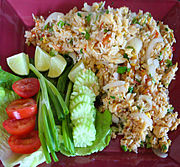
Thai fried rice (Thai: ข้าวผัด IPA: [kʰâo pʰàd], Khao Pad or Khao Phad) is a variety of Fried rice that is prepared in the style of central Thai cuisine. In Thai khao is rice and pad means of or relating to being stir-fried. One of the ways the dish differs from Chinese fried rice is that it is prepared with Thai Jasmine rice instead of regular long-grain rice. It normally contains a meat (chicken, pork, beef, shrimp, and crab are all common), egg, onions, and tomatoes. Green onions, coriander, and fried garlic are then mixed in. However, each individual place varies as it is a ubiquitous dish. Then seasonings are poured in, including soy sauce, sugar, salt, possibly some chili sauce, and the ubiquitous nam pla (fish sauce). These are stirred in, and then the dish is plated and served with accompaniments like cucumber slices, tomato slices, lime and sprigs of green onion.

Other dishes include Coconut Fried Rice (ข้าวผัดมะพร้าว Khao Pad Maprao), and Pineapple Fried Rice (ข้าวผัดสับปะรด Khao Pad Saparod). Khao Op Saparod is a fancier fried rice pineapple dish with raisins and nuts and almost always comes served inside a cutout pineapple.
Common variants:

- Khao Pad Moo, pork fried rice.
- Khao Pad Gai, chicken fried rice.
- Khao Pad Goong, shrimp fried rice.
- Khao Pad Poo, crab fried rice.